
From Conversation to Connection Planning Ahead Launches the Community Café
A strong emergency plan starts long before a storm, outage, heat wave, or family crisis. It often starts with a simple conversation between neighbors.
On August 15, Planning Ahead brought community members together for the Planning Ahead Community Café, an interactive experience designed to uncover the strengths, resources, and relationships that already exist within communities.
Held at Brier Creek Community Center, the inaugural Café invited participants to look beyond traditional emergency preparedness and focus on an equally important resource: each other.
The guiding question was clear.
What happens when a community stops asking only what it needs and starts asking what it already has?
That question shaped the full experience, from individual reflection to small-group problem solving. The result was a practical, people-centered approach to readiness that treated residents not as passive recipients of help, but as active partners in preparedness.
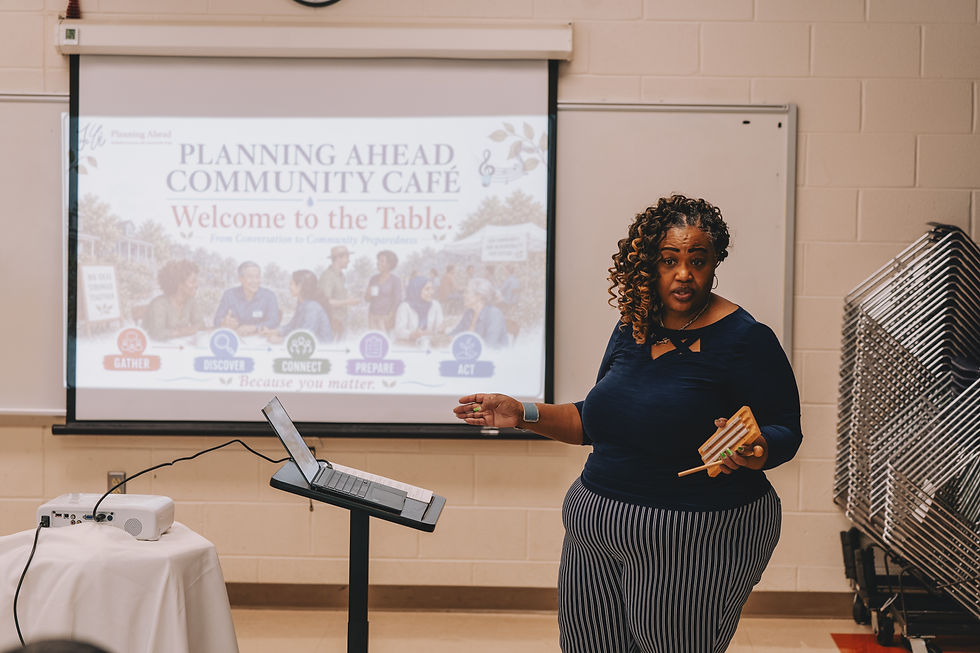
The Community Café began with what people already carry
The Community Café is part of Planning Ahead’s Crisis to Readiness initiative. Its foundation is simple: every community already has strengths that can become powerful resources during everyday challenges and emergencies.
That belief shaped the opening activity. Participants began by identifying assets within their own households across five areas:
Skills
Social connections
Physical spaces
Economic resources
Cultural assets
This first step asked people to notice resources that are often overlooked.
A household skill might be cooking for a group, fixing a generator, checking on an older neighbor, translating information, caring for children, organizing supplies, or knowing how to navigate local services.
A social connection might be a faith group, a school community, a neighborhood association, a walking group, a barber shop, or a trusted family network.
A physical space might be a shaded porch, a community room, a garage, a large kitchen, or a place where people already gather.
Economic resources do not only mean money. They can include shared tools, access to transportation, bulk purchasing habits, or knowledge about where to find affordable supplies.
Cultural assets include traditions, languages, shared histories, mutual care practices, and local knowledge that help people understand what support looks like in real life.
The activity helped participants see preparedness as something closer to home than a checklist. It also made space for the kinds of knowledge that formal plans can miss.
A community may have people who know which households need a wellness check after a power outage. It may have residents who understand which streets flood first. It may have trusted messengers who can share information quickly. It may have caregivers, cooks, drivers, organizers, storytellers, listeners, and problem solvers.
Those assets matter.
Small groups turned local strengths into shared solutions
After the household asset activity, the conversation expanded.
Participants joined facilitated small-group discussions built around fictitious communities facing preparedness challenges. These scenarios gave the groups a low-pressure way to think through real issues without putting anyone on the spot.
The task was not to design a perfect emergency plan. Instead, participants worked together to identify existing assets, make connections, and create community-led solutions.
That structure encouraged a different kind of thinking.
Rather than starting with a list of gaps, each group started with resources. Who already knows how to reach isolated neighbors? Where do people naturally gather? Which local spaces could serve as cooling points during extreme heat preparedness efforts? Who is trusted to share updates when rumors spread? What relationships already exist between residents, local groups, and service providers?
This approach is known as community asset mapping, and it changes the tone of preparedness work. It does not ignore needs or risks. It simply refuses to define a community by what it lacks.
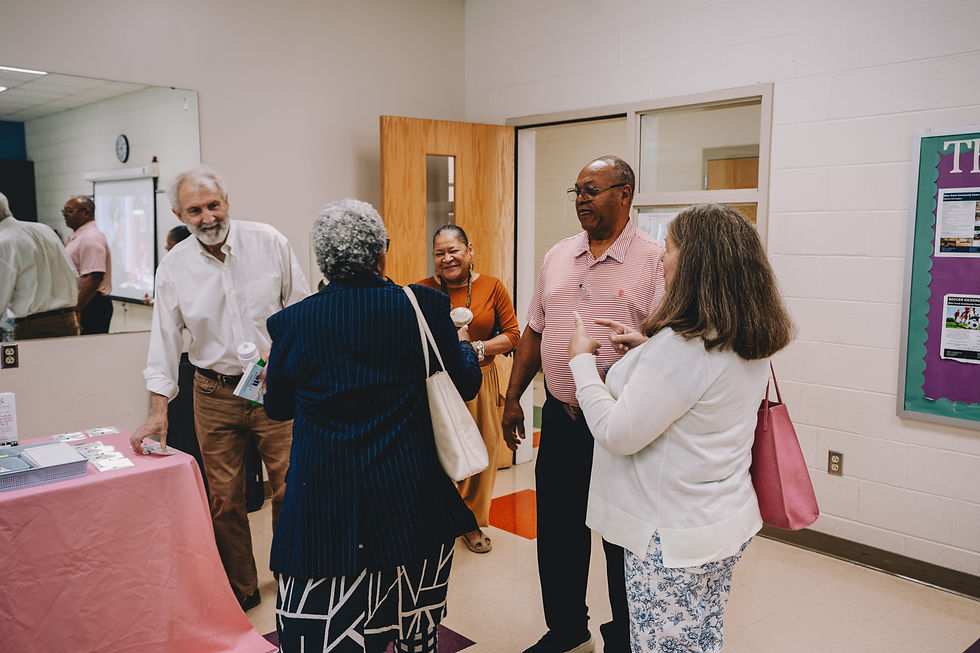
The small-group format also showed how quickly ideas grow when people hear from one another.
One person might name a community room. Another might know who has a key. A third person might know which neighbors need transportation. Someone else might suggest a phone tree, a shared meal, or a way to check on people during dangerous weather.
Preparedness became more practical because it became more connected.
Preparedness became a shared responsibility
The goal of the Community Café was not simply to host another workshop.
Planning Ahead designed the experience to help participants recognize that preparedness is something communities can build together.
Traditional emergency preparedness often focuses on individual steps. Make a kit. Write a family plan. Store water. Sign up for alerts. These steps matter, and every household benefits from them.
But individual preparedness has limits.
A person may have supplies but no transportation. A family may have a plan but little local support. A neighbor may receive an emergency alert but not understand it in their preferred language. An older adult may know a storm is coming but need help moving medication, charging a phone, or finding a cooler place to rest.
That is where neighborhood preparedness becomes essential.
The Café helped participants connect personal readiness with collective readiness. A household plan becomes stronger when it includes nearby people. A community plan becomes stronger when it reflects real relationships. A response effort becomes more effective when residents already know who can do what.
This is the heart of community-led preparedness. It does not wait for outside help to define the first step. It starts with local people, local trust, and local knowledge.
For Planning Ahead, this shift matters across many kinds of risks. Storms, outages, flooding, extreme heat, displacement, and everyday family crises all test the same basic questions.
Who knows who?
Who can check in?
Who has space?
Who has skills?
Who can share information in a way people trust?
Who might be left out unless someone plans ahead?
Those questions turn preparedness into a shared practice, not a one-time task.
The launch points to a wider need
Communities across North Carolina and the country face overlapping pressures. Extreme weather is becoming harder to ignore. Power outages, heat risks, flooding, and sudden disruptions can affect daily life with little warning. At the same time, many residents already rely on informal networks to get through hard moments.
The Community Café brought those informal networks into the center of the preparedness conversation.
For communities thinking about community preparedness Durham NC, community resilience Durham NC, disaster preparedness Durham NC, climate resilience Durham NC, and related local planning efforts, the Café offers a useful model. It shows how readiness can begin with trust, shared knowledge, and the resources people already use every day.
That matters because plans often fail when they do not match real life.
A printed emergency guide may sit unread. A public meeting may attract the same small circle of people. A message may go out but fail to reach residents who need it most. A plan may assume access to a car, a smartphone, paid time off, or nearby family support.
A community-centered approach asks different questions before the crisis begins.
It asks where people actually turn for help. It asks who residents already trust. It asks what barriers exist and what strengths are already present. It respects lived experience as a source of planning knowledge.

The Café format also gives people a way to participate without needing technical expertise. Residents do not have to be emergency managers to know their block, their family networks, their cultural communities, or their neighborhood gathering places.
That knowledge can save time, reduce confusion, and build confidence when pressure rises.
Asset mapping made readiness feel local and practical
One of the strengths of the Community Café was its focus on concrete assets.
Preparedness can feel overwhelming when the conversation starts with worst-case scenarios. The Café took a different path. It grounded the work in familiar people, places, and abilities.
That made the conversation more accessible.
Participants could name skills they already had. They could recognize relationships they already depended on. They could imagine how a school parking lot, shared kitchen, shaded outdoor space, community room, or faith-based network might support people during a disruption.
This does not replace formal emergency services. It complements them.
Emergency responders, local agencies, nonprofits, and public systems play vital roles during disasters. But neighbors are often the first to notice when something is wrong. They may be the first to check on a home, share water, offer a ride, translate a message, or connect someone to help.
The Café recognized that preparedness works best when formal systems and community relationships reinforce each other.
It also encouraged participants to think about equity. A community asset is only useful if people can access it. A gathering place may not serve everyone if transportation is limited. A message may not help if it is not shared in the right language or format. A resource list may leave people out if it assumes internet access.
By starting with conversation, the Café created room for these realities to surface.
The Crisis to Readiness initiative centers relationships
Planning Ahead’s Crisis to Readiness initiative focuses on helping communities move from reacting in moments of stress to preparing with intention before those moments arrive.
The Community Café is one expression of that work.
Its format is interactive by design. Participants are not simply receiving information. They are naming strengths, listening to others, testing ideas, and seeing how household assets can connect to wider community readiness.
That process helps shift the emotional tone of preparedness.
Fear can make people shut down. Lists of risks can feel heavy. Technical language can make planning seem out of reach.
Conversation opens another door.
When people talk about what they already know and who they already trust, readiness becomes more possible. It becomes something rooted in daily life rather than reserved for official agencies or emergency experts.
That shift matters for long-term community resilience. A group that has practiced identifying assets together may find it easier to act together later. A resident who realizes their cooking, caregiving, language skills, or neighborhood knowledge matter may be more likely to stay involved. A community that maps its relationships before a crisis may be better prepared to use them when one comes.

The Conversation Continues on October 10th
Planning Ahead's next Community Café will take place:
Saturday, October 10, 2026
10:00 a.m. to 12:00 p.m.
Braggtown Baptist Church: 3218 N Roxboro St., Durham, NC 27704
The Community Café is free to attend, and lunch will be provided.
Participants will also receive an Extreme Heat Resiliency Toolkit to support household preparedness and free access to Planning Ahead's Community Café Facilitator's Guide so they can continue these conversations beyond the event.
If you care about your neighborhood, want to become better prepared, or simply want to discover the strengths already present in your community, we invite you to join us.
Every community is filled with strengths. Let's discover ours.
Interested in Bringing a Community Café to Your Community?
Planning Ahead is interested in working with neighborhoods, community organizations, faith communities, and other partners that want to create opportunities for residents to connect, identify local strengths, and build community-led preparedness.
The Community Café can create space for residents to move beyond identifying needs and begin recognizing the people, relationships, knowledge, and resources they can build upon together.
Interested in hosting, partnering, or learning more about the Community Café? Connect with Planning Ahead to start the conversation.


Comments